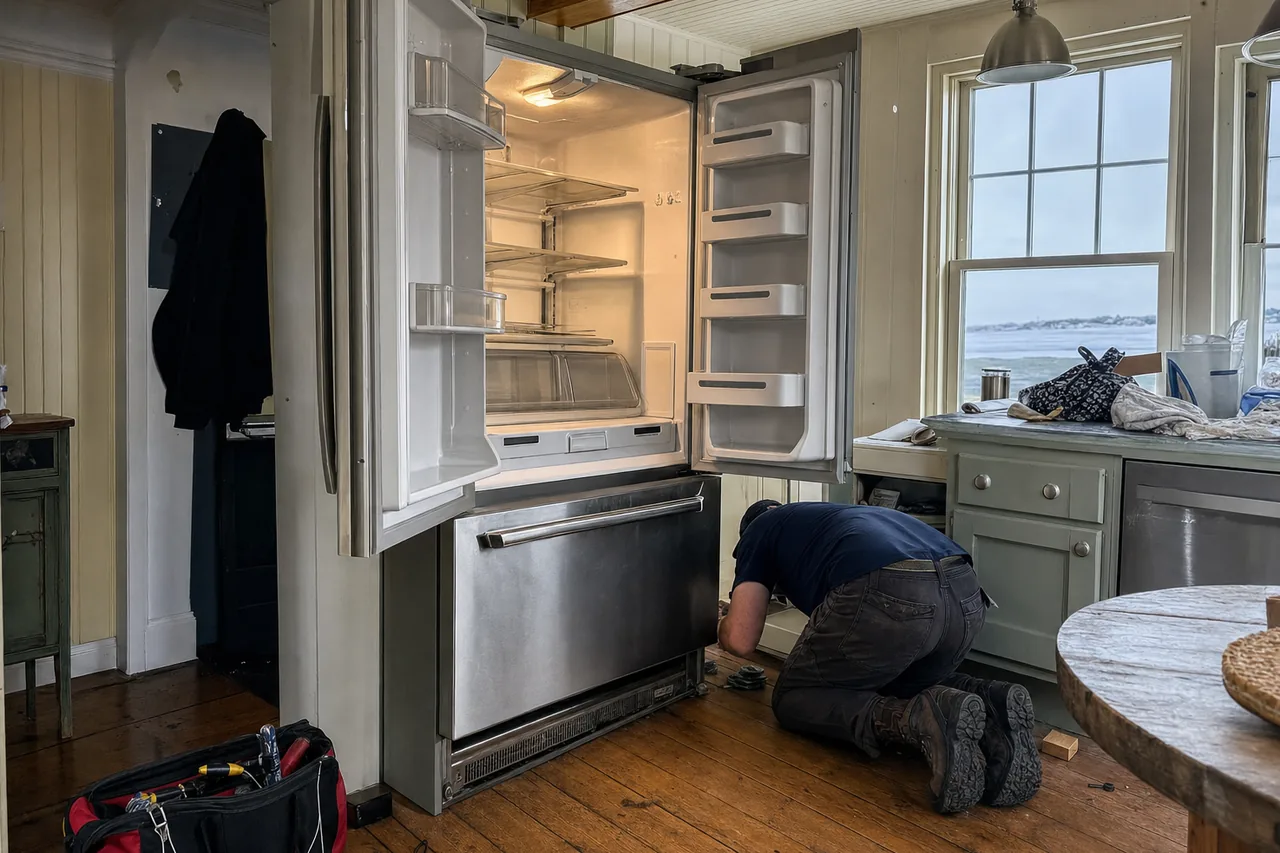
The numbered streets running back from the ocean at Jacksonville Beach are the oldest part of the city, and the first five of them are the hardest place in our service area to keep a professional kitchen working. Two things are true at once on these blocks: the exposure is at its maximum, and the buildings are at their least accommodating.
Exposure, measured in blocks
Chloride deposition falls off with distance from the surf, and it falls off quickly, but the first few streets get the full load. On 1st Street the air coming through an open window in a sea breeze is carrying salt, and it settles on everything — the top of a rangetop, the underside of a hood liner, the condenser grille of a built-in refrigerator, the electrode ceramics on a grill.
What we see on these blocks that we do not see the same way half a mile inland:
- Hood blower housings that corrode through in a fraction of the time, because a hood’s whole function is to pull that outside air through itself.
- Burner caps pitting under the porcelain, then rocking on their seats and throwing the flame pattern out.
- Condenser fins on built-in refrigeration packing with a salt-and-sand deposit that does not vacuum off the way ordinary dust does.
- Spark electrodes leaking to ground through a salt film, so a burner lights and the module keeps clicking.
None of that is dramatic on any one visit. It is a shorter clock on everything.
Old cottage kitchens
The housing stock here runs to the small older beach cottages that were built long before anyone put a 36 or 48 inch professional range in a domestic kitchen. When one of those kitchens is renovated, the appliance goes in and the building does not change much around it.
The consequences show up on every service call in the core:
The cabinet opening is often a fraction narrower than the appliance. That is survivable for cooking and awkward for service, because getting a wall oven far enough forward to reach a hinge, or a range far enough out to reach the gas connection behind it, needs room the kitchen does not have.
The electrical supply behind the wall was sized for a 1950s kitchen. A dedicated circuit for a modern appliance is often the retrofit that never happened, and a shared circuit shows up as nuisance tripping that looks like an appliance fault and is not.
Floors are frequently original — tile, terrazzo or heart pine — and pulling a range out over them without protection is how a service call turns into a flooring bill. We bring protection and we plan the path before we start.
The appliance that was added last
The equipment most likely to give trouble in an old cottage kitchen is usually whatever was added most recently, because it is the piece the building made the least allowance for. A dishwasher squeezed into a run that was never plumbed for one, an ice maker fed by a line run after the fact, a wall oven set into a cabinet built for a smaller box.
That shows up in specific ways. Water-fed equipment installed as an afterthought tends to have a long, shallow drain run to the disposer, and a line that would clear itself on a short fall does not on a long one — which reads to the homeowner as a pump fault and is not. Supply lines run through the back of an older cabinet get kinked behind the machine when it is pushed home, and the symptom is a slow fill rather than no fill. A wall oven in a tight opening runs its cooling fan against a cavity that cannot vent, and the control above the door ages faster for it.
None of that is exotic and all of it is worth checking before anything is ordered, because in every case the part that looks guilty is the expensive one and the cause is the cheap one.
Parking, access and how we plan it
The core has narrow streets, short driveways and a lot of street parking. That is not a detail — a professional range is several hundred pounds and it does not come out of a van and up a set of front steps casually. We ask about the approach when the appointment is booked, so the visit is a repair rather than a survey.
Diagnostic is $80 flat, credited toward the repair. Viking equipment only, and nothing else comes in the van.