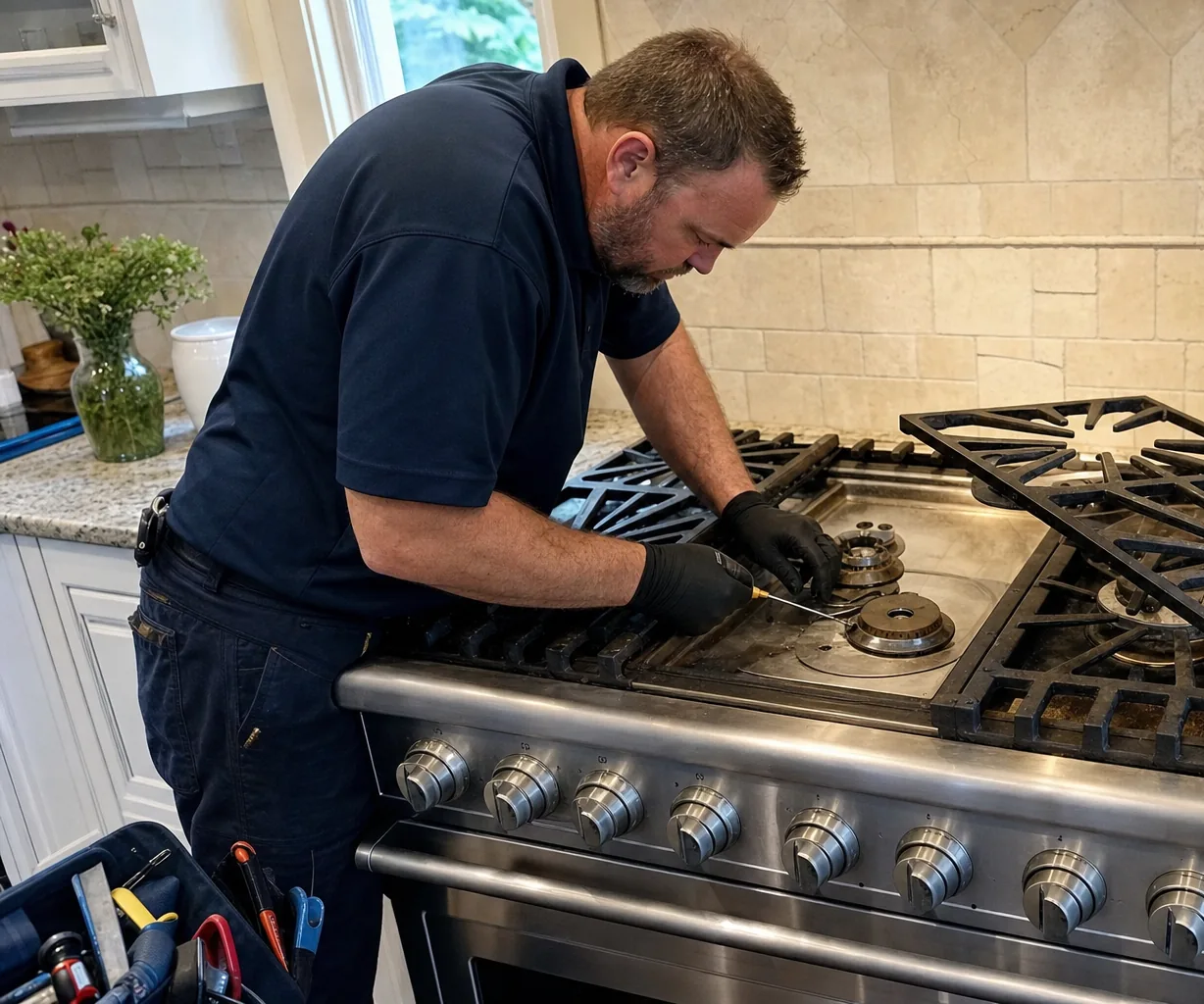
A rangetop is the cooking surface without the oven under it. It drops into the countertop, the cabinetry carries its weight, and in most beach kitchens there is a wall oven or two directly below. That layout changes the repair in two useful ways: everything is reached from above, and the gas manifold sits behind a panel you can get a hand to without moving several hundred pounds of appliance.
Ignition that will not stop
The most common rangetop call is a burner that lights normally and then keeps clicking. That is a spark module that has not seen the flame confirm itself. The electrode is either dirty, wet, cracked at the ceramic, or grounded through spilled material that has bridged the gap.
At the beach there is a fourth cause worth checking first. Salt attracts and holds moisture, and a film of it across the porcelain around the electrode is enough to leak the spark to ground instead of jumping the gap where it should. The burner lights from a stray path, the module never gets its confirmation, and the clicking continues. Cleaning the burner head, the electrode and the porcelain properly, then drying them, fixes a surprising number of these outright.
Continuous sparking is not something to live with. The module is running at full duty and the electrode is eroding the whole time.
Simmer that lifts
A rangetop earns its money at the low end. When a simmer setting will not hold — the flame lifts off the ports, thins out, and either roars or goes out — the cause is usually one of three things: an orifice that is not the right one for the gas supply, a valve that is out of adjustment at its low stop, or a burner port array that has partially closed up.
The gas-type question is worth taking seriously in beach houses that have changed supply at some point. A rangetop set up for one gas and fed another will work well enough at high fire and behave badly at low fire, and the low end is exactly where the fault shows.
Caps, grates and the salt
Burner caps that rock in place are not a small thing. The cap sets the port geometry, and one sitting a degree out of flat throws the flame pattern into the neighbouring cap. On the coast the cause is usually pitting on the underside where the porcelain chipped and chloride got beneath it. Once the seat is eaten away the cap does not sit right again and cleaning will not bring it back.
Grates are more forgiving. Pitting on the top surface is cosmetic for years. We will tell you when a grate is genuinely finished — usually when a foot has corroded through and the grate no longer sits level — and not before.
Gas smell
If you can smell gas at the control panel when a knob is turned, stop using the rangetop and call. That is a valve stem seal or a manifold connection, both of which are repairable, neither of which should be left. This is not an emergency-call-out operation, so if the smell is strong or continuous, shut the supply off at the appliance valve and contact the gas utility first.
The visit
The $80 diagnostic covers ignition and flame quality on every burner, low-end behaviour on each valve, cap and grate condition, the griddle or simmer plate if one is fitted, and the manifold and supply connections. Written estimate before any work. Genuine OEM parts only, 90 days on labour and 365 days on parts.