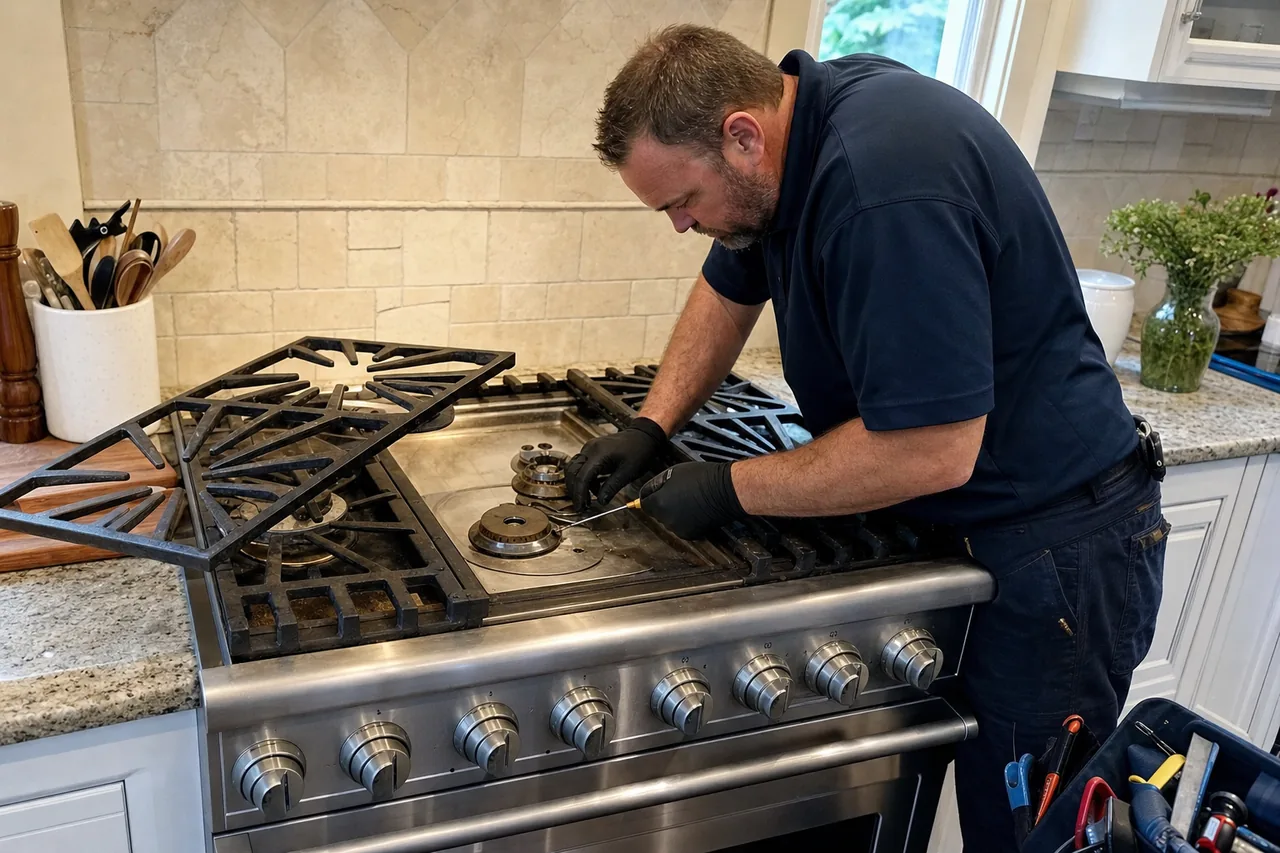
A professional range is the one appliance in a beach kitchen that is expected to last decades, and it usually can. What shortens it here is not the cooking. It is the fact that the top surface of the range spends its whole life in air carrying chloride off the Atlantic, and the bottom half of it sits in a cabinet opening that was often cut for something else.
Surface burners
Ignition problems at the beach are nearly always a surface problem before they are an electrical one. A burner that clicks and clicks without catching usually has a spark electrode that is either fouled with spillover or sitting a fraction too far from the cap. On the coast a third possibility joins them: the cap itself has pitted, the port edges have lost their shape, and the gas leaving them no longer arrives where the spark is.
An orange, ragged, or lazy flame on one burner and one burner only tells the same story from the other direction. Ports partially blocked by corrosion product change the air-to-gas mixture locally. Cleaning helps for a while. Once the porcelain coat on a cast cap has chipped and the chloride has worked underneath it, the cap is consumable and replacing it is cheaper than chasing the symptom every few months.
Grates take the same damage without affecting performance. Pitted grates are ugly and structurally fine for a long time. We will say so rather than sell you a set.
The oven
Heat that drifts is a sensor conversation first. An oven that reads correctly on its own display and wrong on a thermometer sitting on the centre rack is telling you the control and the cavity disagree, and there are only a few places that disagreement can come from: the temperature sensor itself, the connection back to the control, or a door that is no longer sealing.
Doors are worth checking before anything expensive is ordered. A professional range door is heavy, it hangs on hinges that carry that weight through thousands of cycles, and a door that has sagged even slightly leaks heat from the top corners. The oven then runs its elements or burner longer to hold setpoint, the cavity temperature swings wider, and baking goes strange before roasting does. That is a hinge and gasket job, not a control board.
Slow preheat with no other symptom points at output rather than measurement: one of the two heat sources not contributing, or a gas oven burner running with a partially obstructed port array.
Getting to the back of it
This is where a beach house makes the job different. A professional range is several hundred pounds of steel, and the gas connection and the electrical supply both live behind it. Anything that needs the back of the machine needs the machine moved.
In a raised-slab or second-floor kitchen, with the original tile in front of it and a doorway narrower than the appliance, that is a planned operation. We ask about the approach before the visit rather than discovering it with the range half out. Floor protection, a second person, and a realistic path to the back of the unit are decided in advance.
What the visit covers
The flat diagnostic is a full pass: ignition and flame quality on every burner, oven calibration against an independent thermometer, door seal and hinge condition, and the electrical supply behind the unit. You get a written estimate before anything is opened up or ordered, and the diagnostic comes off the repair if you go ahead.
Parts are genuine OEM. On a range that is expected to outlast two kitchens, a pattern part in the gas train or the control is a false economy and we do not fit them.