Skip to content
The arithmetic

Repair it, or replace it

Two tables and a division sum. What the repair costs, what the machine costs, and which of those two numbers is the larger — for Viking equipment specifically, not appliances in general.

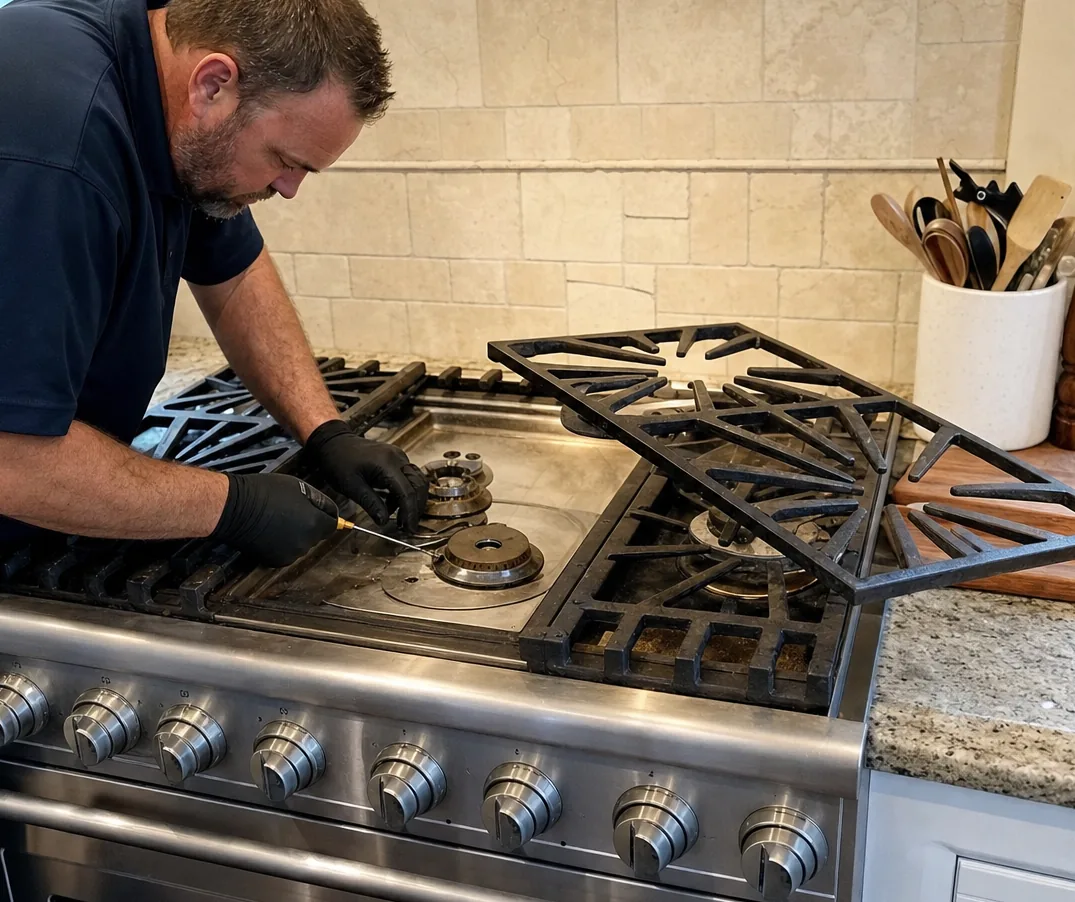
Technician measuring at a stripped burner on a professional range, one cast grate stood on edge against the backsplash
The number that settles repair-or-replace is written down here, not guessed at the kitchen table.
The rule of thumb 50%

repair against replacement — the usual line

Where the fifty-per-cent rule comes from

Almost everybody arrives at this question with the same rule already in hand: if the repair costs more than half of a new machine, buy the new machine. It is repeated everywhere because it is a genuinely good rule — for the appliances it was written about, which are the ones sold at a few hundred dollars and replaced without ceremony.

Viking, the kitchen-appliance manufacturer, does not build those. The rule does not change; the second number in it does, and it changes by an order of magnitude. That is the whole of the answer on this equipment, and it is why the table below has a third column.

Nothing below is a recommendation about your kitchen. It is the published repair bands from the pricing page divided into the cost of a comparable new machine, and the division is done at build time from the same figures a reader is shown.

The sum

Every repair we publish, against the machine it sits in

The third column is the top of the repair band as a share of the cheapest comparable new machine — the worst case for the repair, in other words. The $80 diagnostic is not in it, because it comes off the repair once the work is approved.

Each published repair band, the replacement it is measured against, and the top of the repair band as a percentage of the cheapest comparable new machine.
The repair Parts and labour Measured against At worst
Igniter or burner assembly $190–$540 Professional range, the usual repair-or-replace comparison 8%
Oven thermostat or heating element $190–$600 Professional range, the usual repair-or-replace comparison 9%
Control board or touch panel $410–$1,010 Built-in dishwasher 63%
Refrigeration fan or defrost system $240–$660 Built-in refrigerator or column 7%
Dishwasher pump or control $220–$730 Built-in dishwasher 46%
Compressor or sealed-system repair $930–$2,630 Built-in refrigerator or column 28%

Ranges, not quotes. A range is what an appliance this size can honestly be described by before anyone has opened it; the firm figure is written down after the diagnostic and before a part is ordered. Every repair carries 90 days on labour and 365 days on parts.

The other half

What the replacement actually costs

A comparable Viking range, built-in refrigerator or dishwasher, appliance only — before delivery, installation or cabinetry. National appliance pricing, not Florida labour.

Replacement cost by machine type, appliance only, before delivery, installation or cabinetry.
Instead of repairing Appliance only
Professional range, the usual repair-or-replace comparison $6,500–$14,500
Built-in refrigerator or column $9,500–$17,500
Built-in dishwasher $1,600–$3,200

What that column does not carry: delivery, haul-away of the old machine, the electrical or gas connection, and — the one that catches people out on a built-in — the cabinetry. A new column or a new range is rarely the same size as the hole the old one came out of, and the joinery to close that gap is not an appliance cost. Every one of those pushes the replacement figure up, which is to say every one of them pushes the third column above further down.

When the repair is not a close call

Of the 6 bands published on this site, 3 land under a fifth of the cheapest machine they could be fitted into, and most of those land under a tenth: igniter or burner assembly, oven thermostat or heating element, refrigeration fan or defrost system. At those proportions the rule of thumb is not being applied, it is being ignored, and rightly. A working machine with one failed part is worth the part.

This is the bulk of the work at the beach, and it is not an accident. Exposure takes the cheap things first — a burner cap and its electrode, a condenser fan, a defrost heater, a pump seal — long before it reaches anything expensive. What is worth arguing about is not whether to fix it but whether the cause is still in the house, because a part fitted into an unfixed cause is the same repair bought twice.

When it is a judgement call

Between a fifth and half sit dishwasher pump or control at 46% and compressor or sealed-system repair at 28%. Both are still under the line, and both are where the reflex answer is most often wrong — in opposite directions.

A sealed-system failure sounds terminal and reads as terminal, and on a built-in it is nothing of the sort: the cabinet it sits in is the most expensive thing in the kitchen, so even the dearest repair in this book is a fraction of replacing it. The dishwasher runs the other way. Its repair band is modest and the machine it sits in is the cheapest one here, so the same sum that clears a compressor comfortably brings a pump close to the line.

What tips either of them over is not the price of the one repair, it is the second one. An appliance that has already had a board, or has water damage in more than one housing, or is showing corrosion where the repair cannot reach, is a different arithmetic — and it is explained at the kitchen table, on the written estimate, not asserted here.

When the rule actually fires

One band does cross it: control board or touch panel, $410–$1,010, measured in the cheapest machine it can sit in — a built-in dishwasher starting at $1,600 — which puts it at 63% at worst. The dishwasher is the honest exception on this equipment, and it is the one place where the rule everyone arrives with does real work. A machine that needs its control as well as its pump has spent most of a new one, and you will be told that on the estimate rather than sold the repair.

There is one more case the tables cannot show, because it is not a repair at all: a cracked cooking surface, a split cabinet liner, a burnt-out mains connection inside a housing that has corroded through. Those are replacements wearing a repair's clothes, and the honest answer to them is given on the telephone rather than after the $80 visit.

How long should it have lasted?

The question behind the question, usually. There is no figure published here for it, because this shop has not measured one and a number invented for a web page is worth nothing. What the trade generally observes is that professional cooking equipment outlives the kitchen it was fitted into, and that sealed refrigeration is the part of a built-in that sets the end of its life rather than the cabinet or the doors.

On this coast the variable that moves it most is not age and not use. It is exposure — which is why the equipment three blocks from the Atlantic and the identical equipment four miles inland do not have the same working life, and why the field notes on this site keep coming back to it.
Asked before the visit is booked

Is it worth fixing, or should I just replace it?

On this equipment, nearly always worth fixing — and the tables above show it rather than assert it. A comparable new machine is $4,800–$17,500 before delivery, installation or cabinetry, and most published repair bands land under a tenth of that. The dishwasher is the honest exception.

What is the most expensive part to replace?

On refrigeration, the sealed system — compressor, condenser or a refrigerant leak — at $930–$2,630. On cooking equipment it is the control board at $410–$1,010. Both are quoted from the published bands after the $80 diagnostic, never guessed from a symptom described on the telephone.

Do you charge by the hour to work this out?

No. There is no hourly meter and no call-out charge stacked on top. $80 flat, per appliance, per visit, buys the whole diagnostic sequence and comes off the repair once the written estimate is approved. The repair is then priced from the published bands, not from time spent.

Not the question you had? It is answered on the questions page, or on the phone — +1 (904) 395-4339 .