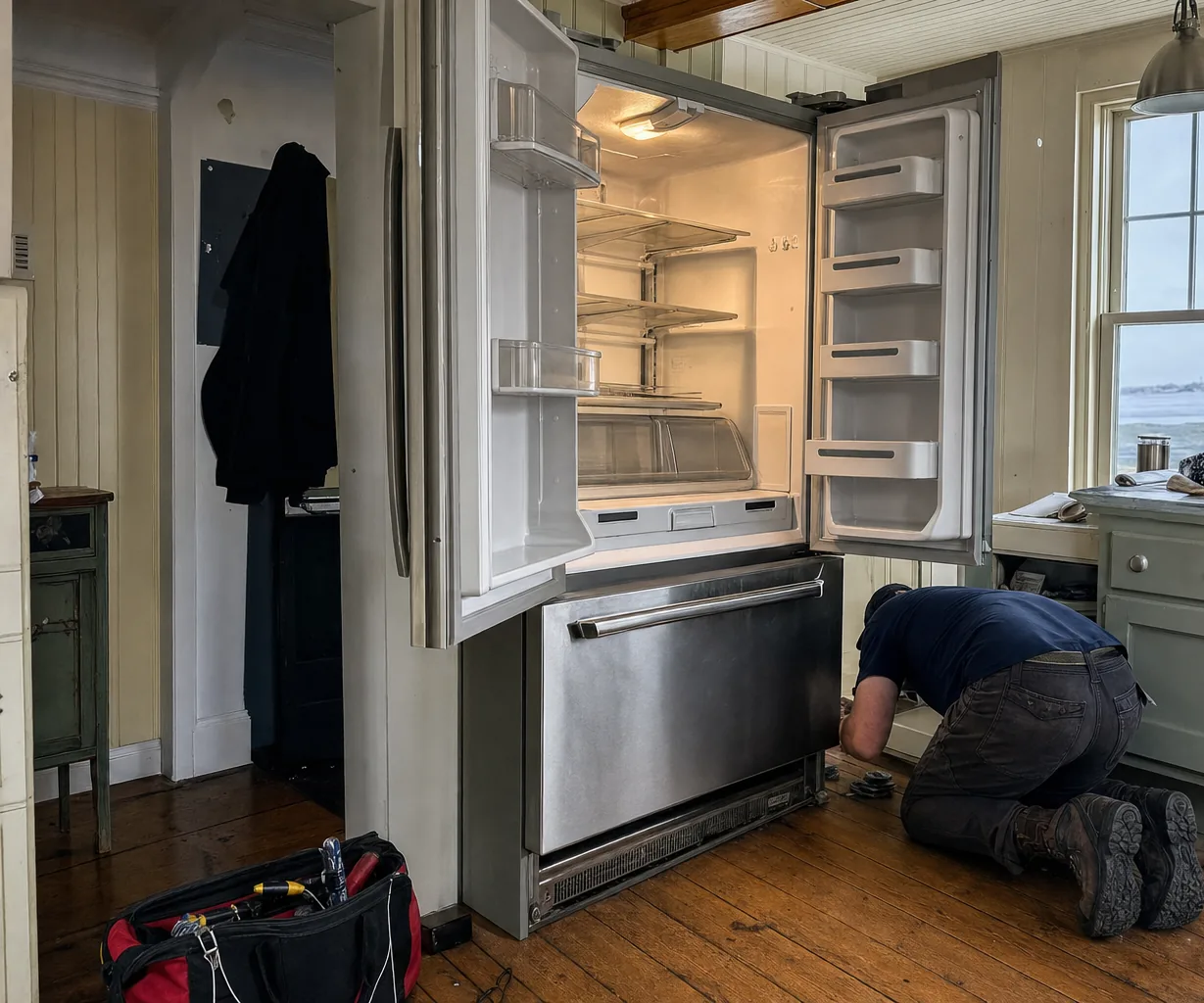
Neptune Beach is the smallest of the three Duval County beach towns, wedged between Atlantic Beach to the north and Jacksonville Beach to the south. It is also the town where the practical side of a repair — getting to the appliance, getting it out, and getting the right part back to it — takes up the largest share of the job.
Access is the first conversation, not a formality
The town is small, dense and largely older. Streets are narrow, lots are tight, driveways are short, and a good proportion of the housing predates the idea of a professional range in a domestic kitchen. A 36 or 48 inch range weighs several hundred pounds and a built-in refrigeration column is worse, because the weight sits high in a narrow cabinet and the unit is unstable the moment it is off its rails or rollers.
So before the visit is booked we ask four things:
- Where the kitchen is, and what is between it and the front door.
- What the floor is. Original tile, terrazzo and heart pine all need protecting before anything heavy crosses them, and that protection comes with us.
- Whether the appliance can come forward at all. Millwork finished around a built-in, a countertop overhanging the top edge, or an opening scribed to a narrower machine all mean something has to come off first.
- How the appliance arrived. If it came in before the doorway trim, the flooring and the island were finished, it may not be able to leave the same way.
That is not administrative caution. On a heavy built-in, the access plan is what decides whether the work is one visit or three.
Older kitchens, retrofitted equipment
The same houses tend to share a second constraint: the electrical work stopped at the visible outlets. A modern built-in sharing a circuit with half the room produces symptoms that look exactly like an appliance fault — a control that resets under load, an oven that loses a function when something else switches on, nuisance tripping that follows the wrong appliance. Supply and grounding get measured before a control board is ever quoted, because a board fitted into that situation fixes nothing and is not a cheap way to find out.
Parts, and why the serial number matters more than the model
Professional equipment is built in series, and a series is revised during its production life. Two ranges that look identical across a room can take different igniter assemblies, different bake elements, different door hinges and different control boards, depending on where in the run they were built.
That is why we ask for the serial number as well as the model number, and why we read it off the data plate rather than off a receipt. The plate is behind the door, under the lid, or on the frame beside the opening depending on the appliance. Getting it right before the visit is the difference between a part that goes on that day and a part that goes back.
Some components are stocked and travel in the van. Others are ordered against that serial, and a written estimate says which one you are dealing with before you approve anything, rather than after.
Repair or replace, honestly
Built-in equipment is not a like-for-like swap. A professional range or a built-in column is fitted into an opening, a supply and a run of cabinetry that were finished around it, so replacing one is rarely just the price of the new machine — it is the machine, the removal, the fit, and frequently joinery.
Which means the arithmetic on an older appliance in one of these houses usually favours repair for longer than it would inland. Where it does not, we will say so: a sealed-system failure on an old refrigeration unit, or a fault we cannot explain the cause of, are the two cases where spending more chasing it is not in your interest. Honest scope limits are part of the diagnostic, and there are faults that belong with the manufacturer rather than with us.
The salt is still the salt
Neptune Beach sits on the same stretch of Atlantic coast as its neighbours and the corrosion mechanisms are identical: hood blower housings giving out early, burner caps pitting under a chipped porcelain coat, condenser fins on built-in refrigeration loading up with a deposit that does not brush off, spark electrodes losing their spark to a salt film across the ceramic.
How we work here
Monday to Friday 8:00am to 6:00pm, Saturday 9:00am to 4:00pm, by appointment. The diagnostic is $80 flat, credited toward the repair, with a written estimate before anything is opened or ordered. Genuine OEM parts, 90 days on labour, 365 days on parts. Viking equipment only.