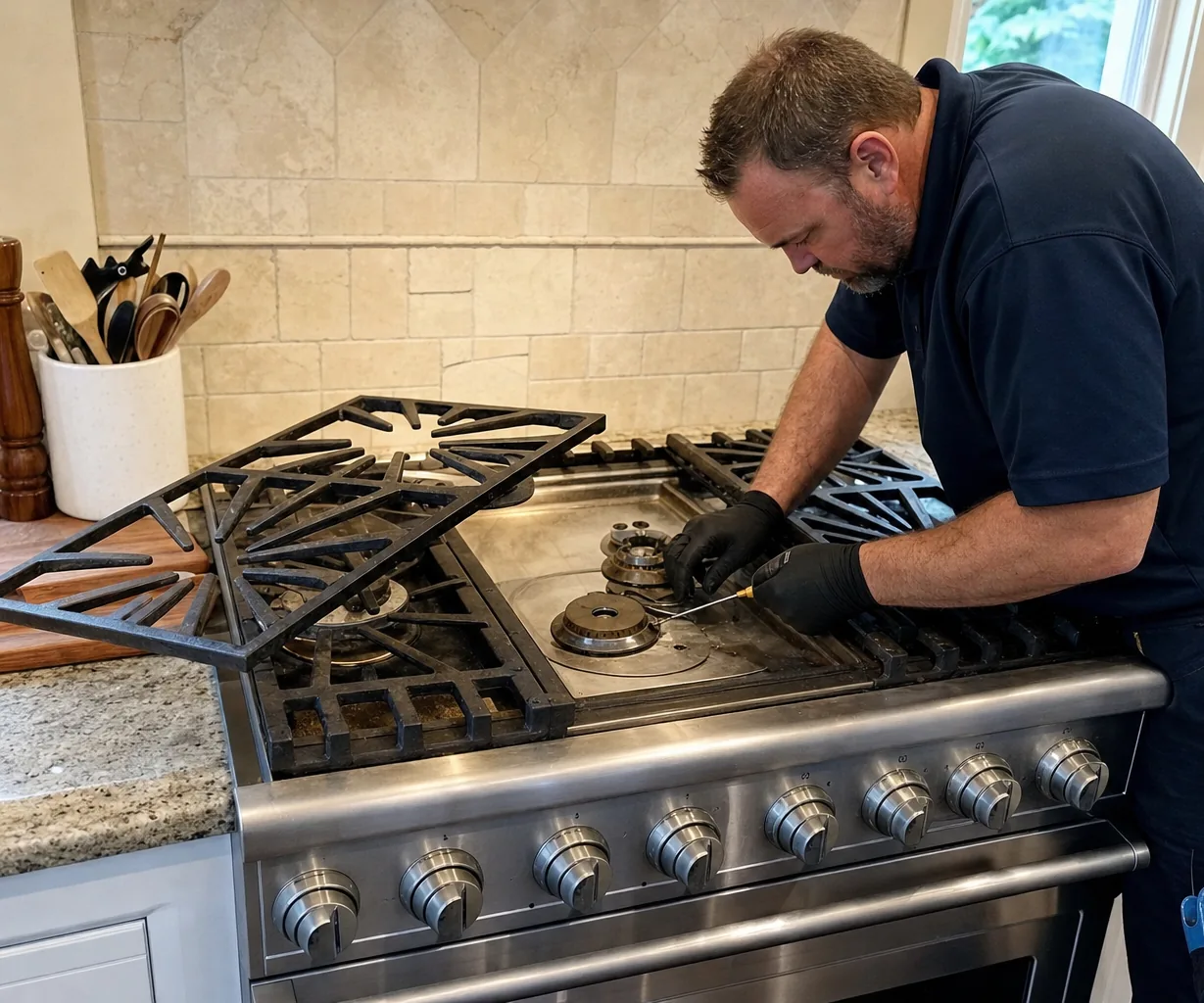
A cooktop is the shallowest appliance in the kitchen. There is often no more than a few inches between the underside of the glass or the burner box and whatever is in the cabinet below, and everything electronic lives in that gap. Heat, moisture and salt all collect there, and all three shorten the life of the control.
Touch controls that stop answering
Capacitive touch controls work by sensing the change in a small electrical field through the glass. Anything conductive sitting on the surface joins in. On the coast the usual offender is a thin salt film left behind after wiping with a damp cloth in a house that runs humid, which is enough to make a control read phantom touches or ignore real ones.
The test is dull and it works: clean the surface properly with something that leaves no residue, dry it fully, and see whether the behaviour changes. If a zone still refuses to answer while the others work, the problem has moved into the touch board or the ribbon connection behind the glass, and that is where the humidity does its slower damage — connector pins corroding at the crimp.
An induction zone that drops out
Induction generators do not like heat. Each zone runs a power module with its own cooling fan, and the fan pulls air through the cabinet space under the counter. When that airflow is restricted — by a drawer stack packed tight, by an undersized cutout, or by a fan that has picked up enough dust and salt to slow down — the module protects itself and drops the zone. It usually comes back after a few minutes, which is the clue.
A zone that drops out only under a heavy pan, or only when two zones on the same side are running, is a thermal protection story almost every time. A zone that never works at all is a coil or a module.
Radiant elements cycling wrong
An electric radiant zone does not vary its power smoothly. It cycles on and off against a limiter, and the ratio of on to off is the setting. When an element glows and cuts out too early, over and over, the limiter is doing its job for a reason — a poor connection at the element terminal generating heat where it should not, or a limiter that has drifted.
That terminal is the part that suffers here. Salt-laden humid air reaches under the cooktop, the crimp corrodes, resistance climbs, and the connection heats under load. It is a cheap part and a real fire risk if it is ignored.
Storms and controls
The beaches see roughly sixty-eight thunderstorm days a year. Cooktop controls sit on the same circuits as everything else, and repeated small surges and brief outages age a board rather than kill it outright. A cooktop that has become intermittent after a stormy fortnight is not a coincidence, and it is worth checking supply and grounding as part of the diagnosis rather than replacing a board and waiting for the same thing to happen again.
Cracked glass
A hairline crack from an edge of a glass surface ends the repair conversation. The surface is the safety barrier over live components; it is replaced, not patched, and we will say so plainly rather than take a fee to look at it twice.
The visit
$80 flat, credited to the repair. It covers every zone under load, the control and its connections, the cooling path under the counter, and the supply. Written estimate first, genuine OEM parts, 90 days labour and 365 days parts.